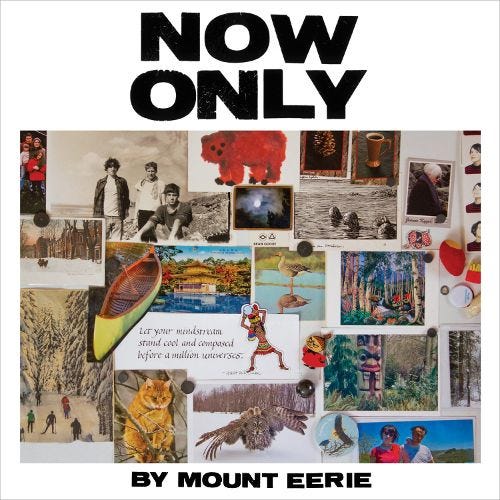
Mount Eerie, Now Only


Mount EerieNow Only

This is the second album Phil Elverum has devoted to dealing with the death of his wife Genevieve. As with 2017’s A Crow Looked At Me, every word is clearly, brutally autobiographical. The words, and Elverum’s grief, take center stage and are not particularly lyrical; as before, the plucking and strumming exist in service to them. But Now Only displays more musical dexterity and hints of structure; one song even has a chorus. The tone, too, is more varied; they are all songs of loss, but whereas its predecessor was one dive after another into bleak, haunted desolation, Now Only offers different shades. All of them are difficult, and none are trite — only on the penultimate song does Elverum even begin to contemplate moving forward, and his heartache still reasserts itself plenty even after that. Elverum is still grieving, but he’s working with that grief, and we’re all lucky he’s willing to share that journey. Highlights: “Now Only,” “Earth,” “Two Paintings by Nikolai Astrup”

Comments

Popular posts from this blog

Richard Thompson, 13 Rivers

Richard Thompson ,  13 Rivers Richard Thompson — 13 Rivers Arguably the most consistently engaging artist of the last 50 years, Richard Thompson continues to write deep, dark folk-rock songs with an acerbic wit married to a soft, calm wisdom. This new album isn’t widely divergent from his established catalogue but miraculously Thompson, who was already a guitar hero in the 1970s, still manages to grow as a guitarist and sound fresh. Working highly intricate riffs into the undergirding of each song’s frame, he also solos on every song and as usual, his virtuosity remains connected to the music, always moving the songs forward rather than grandstanding. Plus, Thompson’s one of a kind voice only deepens in resonance over time. Highlights: “Trying,” “O Cinderella,” “Bones of Gilead”

Don Kipper, Seven Sisters

Don Kipper ,  Seven Sisters This seven-piece world music collective plays “the traditional music of northeast London,” by which they mean music from the ethnic communities that thrive there. Turkish, Romani, Klezmer, North and West African, Greek and Macedonian music (and probably others) share the stage, each taking moments in the spotlight and then often weaving together in combinations. The band’s third album features a mixture of originals and traditional songs of various heritage. The band displays quite a range, with slow-build epics and chorus-y folk songs featuring the intoxicating vocals of lead singer Dunja Botic, to high every, whirling, up-tempo instrumentals like the record’s climax, “Gambrinus,” that sound remarkably tight for songs in which there is so much going on. Other highlights: “Welcome,” “Min Orkizese”

Jacob Banks, Village

Jacob Banks ,  Village With the British, Nigerian-born future soul singer’s full-length debut, Jason Banks discovers the point at which today’s forward-thinking alternative R&B comes full circle and connect with classic R&B. Banks’s arrangements are contemporary, much of his instrumentation electronic and advanced, and he makes relevant enough cultural references to blend in with the hip hop set. his voice, though, recalls the soul men of yore, with a mighty, stirring baritone of which he is in full command. His voice rings out with power and sensitivity in equal measure. Banks brings some fusion from outside R&B world too, with traces of reggae and African sounds. This one’s worth checking out even if you don’t think you like soul or R&B. Highlights: “Kumbaya,” “Caroline,” “Unknown (To You)”